
RIL subsidiary Reliance New Energy Solar, Ola Electric, Hyundai Global Motors Company and Rajesh Exports have been approved for receiving incentives under the Rs 18,100 crore Production Linked Incentive (PLI) scheme for battery manufacturing in India, sources said on Thursday. "The ministry had received bids from 10 companies with a capacity of 130 GWh. Reliance, Ola Electric, Hyundai and Rajesh Exports have qualified for ACC batteries," a source said. Other companies which had applied for the PLI scheme for Advanced Chemistry Cell (ACC) batteries were Lucas-TVS, Mahindra & Mahindra, Amara Raja Batteries, Exide Industries, Larsen & Toubro and India Power Corporation Limited.

New Hyundai Verna 2017 is powered with a choice of 1.6 L petrol engine (Dual VTVT, 121.3 bhp) and 1.6 L diesel engine (U2 CRDi VGT, 126.2 bhp).

Maruti sold 191 units of SX4 sedan in January 2014.

The new financial year started on a mixed note for car makers.
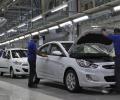
Domestic passenger vehicle (PV) sales saw a significant growth in October due to increased availability of semiconductor chips and rising consumer confidence. The sales figures during the month - which coincided with the first post-Covid festival season - released by the top ten carmakers saw a jump of 30.7 per cent to 322,885 units in October. Auto companies count wholesales - units dispatched to dealers - as sales.
The company said its domestic sales rose by 31.1 per cent during the month to 1,00,964 units as against 77,002 units in June 2013.

If Tesla comes in, India's position as a manufacturing hub will rise many notches, as it will become only the second country, after China, to have both Apple as well as Tesla.

Seven manufacturers together post a 15% decli#8800 M&M, Ford and Honda buck trend.

...But sales of domestic passenger vehicles dropped 2% to 3% year-on-year in August owing to low demand.
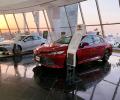
The growth momentum that started during the festival season is likely to sustain in the new year, reports Arindam Majumder.
Your plans to bring home a dream vehicle may just have become a little more distant, with automobile manufacturers considering price increases to offset the impact of higher excise duty levied in the Union Budget.
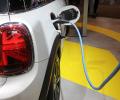
Electric vehicle retail sales in the country witnessed over three-fold jump last fiscal with two-wheeler offtake leading the segment, according to data compiled by automobile dealers' body FADA. Total electric vehicle (EV) retails reached 4,29,217 units in 2021-22, a rise of three-fold from 1,34,821 units in the financial year 2020-21, the industry body said. Total EV sales had stood at 1,68,300 units in the 2019-20 fiscal, it noted.
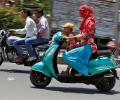
Two-wheeler exports from India have decreased by 20 per cent year-on-year (Y-o-Y) to 1.69 million units in the first half (H1) of 2023-24 (FY24) due to a challenging geopolitical situation and foreign exchange (forex) crises in key markets such as South Asia, industry body Society of Indian Automobile Manufacturers (Siam) said on Monday. On the other hand, passenger vehicle (PV) exports in H1FY24 increased by 5 per cent to 336,754 units because the key markets are much more diversified worldwide, Vinod Aggarwal, president, Siam, told reporters during a press conference. The Russia-Ukraine war, which started in February 2022, has brought significant instability to global fuel prices.
Four companies - Rajesh Exports, Hyundai Global Motors Company, Ola Electric Mobility and Reliance New Energy - are eligible for receiving benefits under the production-linked incentive (PLI) scheme for advanced chemistry cell battery storage, the heavy industries ministry said on Thursday. The allotment was made for a total of 50 GWh of battery capacity to the four successful bidders. These firms, the ministry said, will receive incentives under India's Rs 18,100 crore programme to boost local battery cell production.

For Mahindra & Mahindra (M&M), which has just started executing a comeback strategy for wresting back ground it lost to rivals, this could not have come at a worse time. The maker of the Bolero Neo and the Thar models on Thursday said it would have to halt production at its automotive plant for a week due to the worsening supply situation of semiconductors.
BS-VI emission norms and the COVID-19 lockdown impacted the dispatches.
Maruti Udyog, India's biggest carmaker, has been ranked first in customer satisfaction by international market research firm JD Power.

The price is expected to be around Rs 10 lakh, at par with competition.

Hyundai Grand i10 is the fastest growing car in India, says the company.

Leading automakers Maruti Suzuki, Hyundai and Tata Motors reported decline in wholesales in August as the companies curtailed vehicle dispatches amid drop in demand and to cut inventories at dealer level. Market leader Maruti Suzuki India said its total domestic passenger vehicle wholesales were at 143,075 units last month as compared to 156,114 units in the year-ago month, registering a dip of 8 per cent. Sales of mini segment cars, comprising Alto and S-Presso, declined to 10,648 units last month as against 12,209 units a year ago.
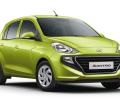
The new Santro, with a premium feel, is proof that when it comes to offering latest features and with it design at competitive prices, small cars are no longer shying away from entering a territory once occupied only by larger models, says Pawan Lall.
Hyundai Motor India Ltd on Wednesday launched a new automatic variant of its diesel powered luxury sedan Sonata Embera CRDi, priced at Rs 15,71,656 (ex-showroom Delhi).

Hyundai Motor India will raise prices of its entire product portfolio in the range of Rs 5,000 to Rs 25,000 from Jan 2015.
With sales sagging despite discounts, car makers are now looking at value-added services to attract customers.
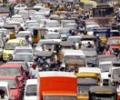
Absence of diesel options, economic slowdown hurt sales
General Motors, Nissan Motor India and Volkswagen managed to ride the tide with new launches.
While Maruti recorded negative sales, Hyundai gained marginally.

While the country's largest car maker, Maruti Suzuki India, said its car will become costly by two per cent, Hyundai Motor India said it will result in a price rise of Rs 6,500-25,000 on average.
Automobile component manufacturers are rejoicing over a sudden 30-40 per cent spurt in demand in February. Analysts are, however, not entirely sure of the reason for this high growth; many are doubtful if it can be sustained, given the other gloomy signals. An analyst says, "Almost all car makers have either completely withdrawn or drastically reduced their promotional offers." Also, payment issues as far as vendors are concerned remains a problem.

The new year has brought good news for almost all car manufacturers, with market leader Maruti Suzuki, Hyundai Motors, Tata Motors, Mahindra & Mahindra, General Motors and even Fiat, posting their highest monthly sales since their inception.
The government seems to have come to the rescue of potential car buyers.
Issues relating to shortage of key automotive components, which were supposed to be sorted out a month ago, will hit production even for the next two quarters, as slow ramp-up and discrepancies in tyre prices impact output.

The concept of the rally organised by Hyundai was to promote fuel efficient driving habits among its customers.
Last month, nine leading vehicle manufacturers sold 213,633 units, 25.8 per cent more than last year.

Maruti Suzuki India said its domestic sales rose 10.6 per cent in May.
Maruti Suzuki India and Tata Motors reported decline in sales during June this year.

Amid slowing volume sales among India's major automakers, Toyota Kirloskar Motor (TKM) has defied the trend with strong growth, driven by demand for hybrid vehicles and a reliable product line up. The company expects this momentum to continue in 2025. "The overall response to our cars has been fabulous. So, we foresee the same momentum in 2025 as well," Sabari Manohar, vice-president, sales-service-used car business, TKM, said.

Open order books in February breach 700,000; wait period for some models exceed a year.
Car maker Maruti Suzuki India Ltd on Monday reported a 15.75 per cent jump in the total sales in May at 79,872 units as against 69,001 units in the same month last year.
